A year and a day
Sir Gawain and the Green KnightA year and a day is the interval that gives the Green Knight’s challenge its binding shape: after the Christmas encounter at Camelot, Sir Gawain must return at the appointed time to receive a blow in return. The phrase converts an extravagant courtly challenge into a long, measurable obligation, and the poem makes that duration felt through the passing seasons and the approach of New Year.
The Appointed Interval
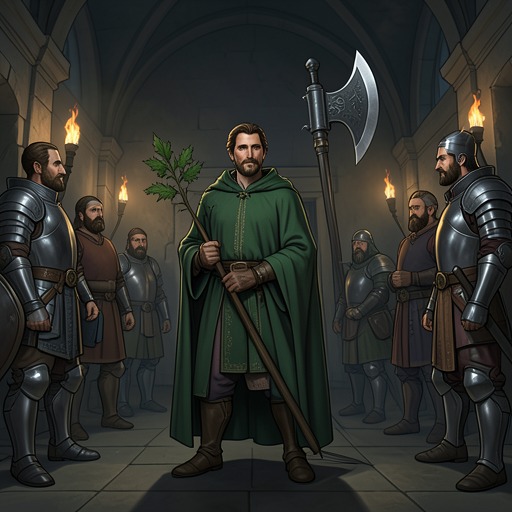
At the Christmas gathering in Camelot, the Green Knight grants a respite of a twelvemonth and a day after his challenge. Sir Gawain answers by promising that, at the corresponding time a twelvemonth later, he will take another stroke from the challenger. The interval is therefore not simply a period allowed for travel: it is the term of a reciprocal agreement, linking the first encounter to a future reckoning.
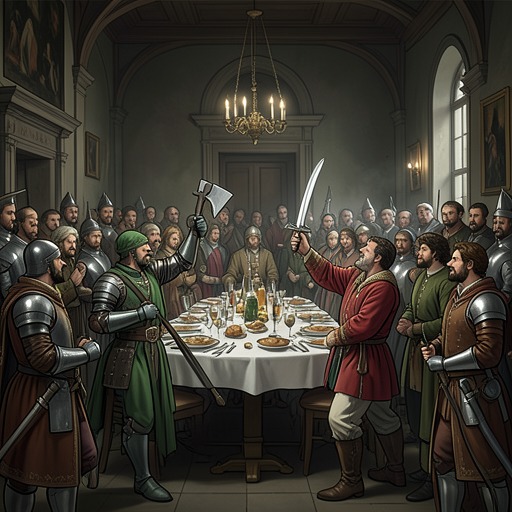
The timing also belongs to the courtly world in which the challenge is staged. The tale presents the adventure as a remarkable undertaking at the court of King Arthur, where the Christmas feast begins with trumpets and bright banners. Against this lavish ceremonial opening, the distant appointment establishes a second, darker measure of time: the promise made amid celebration must remain in force long after the feast ends.
The Year Measured by Seasons
The poem registers the interval through the liturgical calendar rather than by repeatedly counting months. After Christmas comes Lent, when the diet turns from flesh to fish and simpler food. Later, Sir Gawain remains with King Arthur through All Hallows’ Day, and a feast is held there for the company. These seasonal markers make the deadline part of an unfolding year of observances, not an abstract span detached from ordinary life.
The journey and its hospitality have their own calendar points. Sir Gawain rides into a deep forest on a morning in the course of his travels. At the castle, Saint John’s Day is heard as the last day of the festivities, after which the guests are expected to depart at dawn. The sequence places celebration beside movement: the year’s feasts offer brief occasions of welcome, while the obligation to continue toward the appointed meeting remains.
The Deadline Nears
As New Year approaches, the poem makes time newly immediate. The night passes, daylight gives way to darkness, and harsh weather rises outside. The seasonal turn is no longer one marker among many; it signals that the promised term is nearly complete and that Sir Gawain must face the consequence of his earlier pledge.
At the castle, the lord reassures Sir Gawain that he must stay until the term’s end and that the Green Chapel need no longer trouble him. The reassurance is set against the approaching deadline, sharpening the contrast between comfortable hospitality and the appointment that still governs the journey. The interval has brought Sir Gawain through changing seasons and places, but it has not released him from the agreement.
Fulfilment and Recognition
When the appointed encounter concludes, the identity behind the challenge is disclosed: the other man names himself as Bertilak de Hautdesert and attributes the events to the power of Morgan le Fay, who lives in his household. This revelation connects the endpoint of the interval to the concealed design behind the adventure. The year and a day has carried Sir Gawain from a public Christmas challenge to a meeting where the challenger’s identity and the source of the trial become known.